1966-1982
greenleft.org.au/sites/d
efault/files/styles/new_large/public/
public_files/
black-panthers-led8oct06a1.jpg?itok=zm3BgTo6
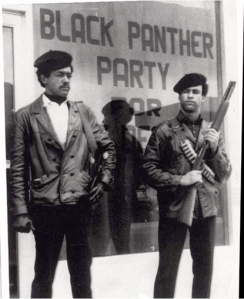
The Black Panther Party for Self- Defense was found in 1966 in Oakland, California. It was a political organization created by Huey Newton and Bobby Seale. Their organization was focused on the Black Power movement, making headlines with its controversial rhetoric and militaristic style.
The main purpose of the party was to battel police brutality against African American people. In order to do that the party had to have people who could patrol the streets of Oakland and other cities. After two years the Panthers numbered about 2,000 people, who agreed to participate and fight for inequality and rights among white and black people.
However, after 16 years of being as party, in 1982 the Panthers Party stopped their mission due to party members’ involvement in violent activities with the police and violent activities within the party. Moreover, the FBI started to weaken the party’s actions by negatively affecting the relationships among black nationalist groups and by trying to destroy community programs created by the party.
Music played a significant role during this time when black people were fighting for rights and justice. Music had power; to fight, protect, and instill dreams of equality.
NINA SIMONE
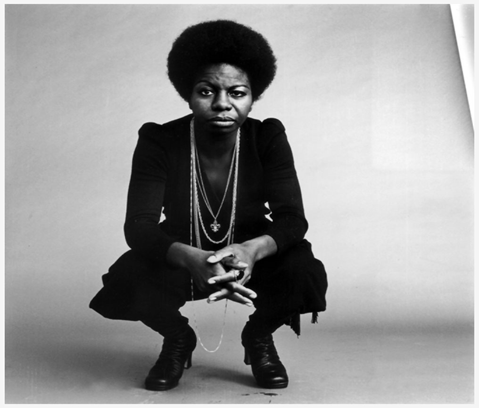
Nina Simone was a singer, songwriter, pianist, and activist. She was someone who crossed the musical boundaries and spoke out against racism and injustice. Her songs included elements of Jazz, Blues, Folk, Rhythm and Blues, and Gospel. As did many artists in the 1960s, Simone used her music to protest the treatment of the African American community. After she signed with Colpix records in the 1950s, she received full creative control over her work, which was thought to be an anomaly at the time, especially for a black female. Nina Simone’s lyrics strongly reflect the civil rights struggles of that day and age.
“Mississippi Goddam” by Nina Simone
“Mississippi Godman” was published on her album called “Nina Simone – in Concert”. She recorded the song in 1964 at Carnegie Hall and introduced this song as “a show tune, but the show hasn’t been written… yet”. The album was based on recordings of three concerts she gave at Carnegie Hall. After she released Nina Simone in Concert, she strongly began to highlight the issues of the times in her music, while in earlier compositions she only slightly touched on racial inequality among African Americans. This album marked Simone as a Civil Rights singer in her recording career. The song was released as a single and later was announced as the anthem for the civil right movement. Because Simone incorporated the civil right message in this album, “Mississippi Goddam” became a political song.
“Mississippi Goddam is a “self-written composition” that took her only an hour to compose. Simone said: “When I heard about the bombing of the church in which the four little black girls were killed in Alabama, I shut myself up in a room and that song happened. Medgar Evers had been recently slain in Mississippi. At first, I tried to make myself a gun. I gathered some materials. I was going to take one of them out, and I didn’t care who it was. Then Andy, my husband at the time, said to me, ‘Nina, you can’t kill anyone. You are a musician. Do what you do.’ When I sat down the whole song happened. I never stopped writing until the thing was finished”.
The lyrics to this song strongly express her frustration and give listeners a glimpse into her feelings and emotions about the bombing:
“Alabama’s gotten me so upset
Tennessee made me lose my rest
And everybody knows about Mississippi Goddam…Can’t you see it
Can’t you feel it
It’s all in the air
I can’t stand the pressure much longer
Somebody say a prayer”…
Simone finishes the song by (rhetorically) refereeing to white people and asking directly for equality:
“You don’t have to live next to me
Just give me my equality…
Everybody knows about Mississippi Goddam” …
“Mississippi Goddam” become one the most critical pieces of her music. In one of the interviews she said that her song writing direction strongly shifted with “Mississippi Goddam”, because of what was happening in Alabama. So for the next seven years she was driven by civil rights movement. Not only that, she was hoping for the black revolution to happen. According the L.A record, she explained that she wrote this song with the purpose to show the “way of my people getting some justice for the first time in 300 years.” However, the song was banned in several Southern states, because of the word “goddam” in the title. Radio stations were refusing this record and returned all the records broken in half.
Charts:
- “Mississippi Goddam” as a song was not rated in any charts, however the album “Nina Simone in Concert” placed 94th out of the top 200 best albums of the 1960s, by the website Pitchfork.
- In 1964 the same album took the position of 102 out of 200 by Billboard.
Nina Simone was a woman who made a significant impact on the legacy of civil right movement and musical industry. I loved how she said “With the arrival of the Panthers, black kids realized there were black heroes who would fight and die if necessary, to get what they wanted.” In 2019, the song was selected by the Library of Congress for preservation in the national Recording Registry the for being “culturally, historically, or aesthetically significant.”
“This song would go on to cement her status as the true singer of the civil rights movement.” -Stokely Carmichael-
“Free Bobby Now” by The Lumpen
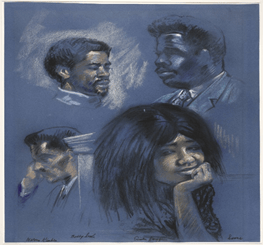
The next song I will discuss is “Free Bobby Now” by the Lumpen. From mid 1970 until early 1971, the Black Panthers supported a musical group called the Lumpen. The band was short lived and was active for only 10 months. Party members Bill Calhoun, Clark (Santa Rita) Bailey, James Mott, Michael Torrance made up the Lumpen. As Michael Torrance pointed out: “Some folks don’t read, but everyone listens to music.” The name was suggested by The Party’s Minister of Culture, Emory Douglas which is short for “Lumpenproletariat” and drawn from a phrase created by the godfather of Communism, Karl Marx. The Lumpen describes the working class that could not realize class consciousness, thus provide them worthless in the pursuit of revolutionary struggle. During their time they released only one single and most of their music was actually covers of popular songs in which they changed the lyrics to use in the black power revolution.
The Lumpen member Bill Calhoun wrote the lyrics for “Free Bobby Now”. This song was better known as “Bobby Must Be Set Free”, because it was composed in order to protest the trial of Black Panthers chairman, Bobby Seale. Bobby was on trial in New Haven, Connecticut, for a trumped-up murder charge.
Here is Bobby Seale story in more depth. On May 21st, 1969, police found the body of 19-year-old Alex Rackley on a riverbank in Middlefield, CT. Rackley was a member of the Black Panther Party. At the time of Rackley’s murder, the organization had several thousand members operating in regional chapters in major American cities. The Panthers growth and their call for violent action against racist institutions made the Party a subject of investigations by local and federal law enforcement agencies. Some Party members, suspected Alex Rackley of being an FBI informant and therefore was murdered by people in the Black Panthers. Bobby Seale, national chairman of the Black Panther Party, and Ericka Huggins, head of the Party’s New Haven chapter, were charged by the state with conspiracy to kidnap and murder Rackley; the investigators sought the death penalty. Many ruminate that the charges against Seale and Huggins, neither of whom were present during the commission of the murder, were issued in an effort to destroy the Party, according Yale University Library article, 2019. On that day in 1970 there were 15,000 Panther Party members and their supporters in attendance to the protest trial in New Haven and to stand up for Bobby Seale.
Lyrics:
The song starts with an explanation of why Bobby went on the streets:
“He walked the streets and carried a gun, yea, yea, yea
To save his people, and family, yea
From those who’ve killed us for four hundred years” …
People ask for the GOD:
“Bobby must be set free
Good, God, almighty!
Set our chairman free!” …
People did not believe Bobby was guilty, that he did not murder his party member. They want to see their chairman FREE:
“They say that he killed a brother, yea, yea
But this we know just can’t be, yea
He’s proven his love for his people
That’s why, Bobby must be set free
Set the chairman free!”...
To wrap up I strongly encourage anyone to view the three minute video where Rasheed Alli’s song “Black Power Revolution” presents the story of Black Power.


